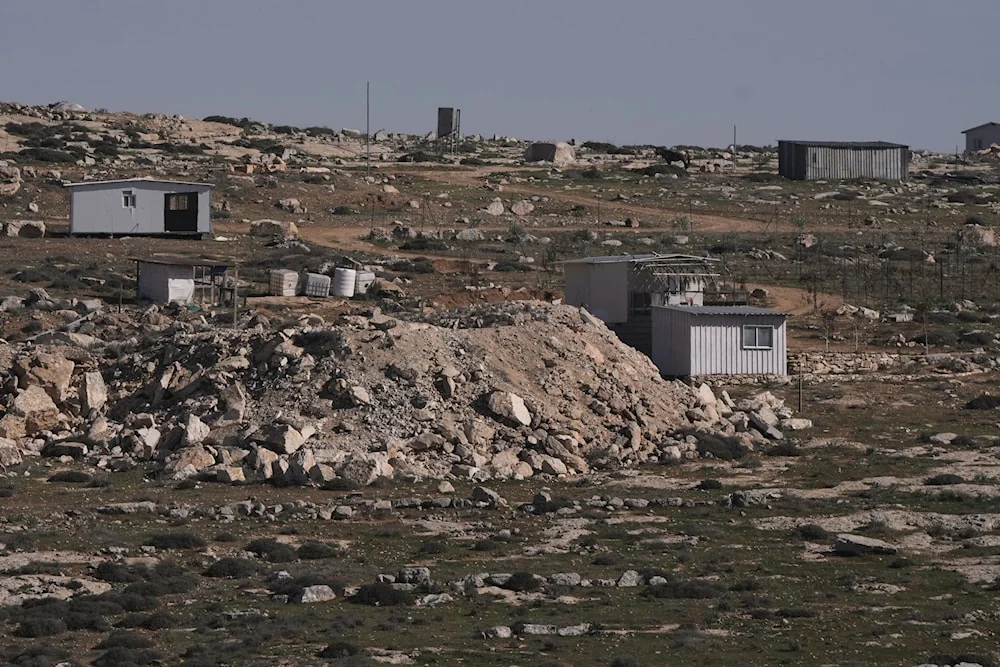
'Israel' forces Palestinian to demolish own home in West Bank
Israeli occupation authorities forced a Palestinian citizen to demolish his own home on Saturday in al-Zaytouna Street in the town of Beit Hanina, north of occupied Palestine, according to the Palestinian news agency WAFA.
The al-Quds Governorate said the Israeli occupation authorities issued a demolition order under the pretext of "building without a permit." The house, which had stood for eight years, covered 35 square meters and consisted of a room, a kitchen, and a bathroom. It was home to Rami and his newlywed wife, the governorate added.
Forced self-demolitions have become a recurring measure imposed by Israeli occupation authorities in occupied al-Quds, compelling Palestinian residents to dismantle their homes or face heavy fines and demolition costs.
The Beit Hanina demolition comes amid continued pressure on Palestinian residents in the West Bank through restrictive building permit policies in territories under Israeli occupation.
Agricultural losses in the occupied West Bank exceed $761,000
In a separate development, losses in the agricultural sector across the occupied West Bankexceeded $761,000, according to the Palestinian Ministry of Agriculture. The ministry documented the uprooting and destruction of 777 trees in various areas during the week between February 5 and 11, attributing the damage to Israeli attacks.
In a report, the ministry said the period witnessed a significant escalation in Israeli violations targeting the agricultural sector in West Bank governorates, with total losses surpassing $761,000.
The escalation included bulldozing and demolition of agricultural infrastructure, sabotage of water sources, widespread attacks on fruit trees, and settler assaults that affected crops and agricultural properties while preventing farmers from accessing their lands.
The Wall and Settlement Resistance Commission reported that Israeli occupation forces and settlers carried out 1,872 attacks during January. According to the commission, the occupation army was responsible for 1,404 attacks, while settlers carried out 468.
The attacks were concentrated primarily in the al-Khalil Governorate, which recorded 415 incidents, followed by the Ramallah and al-Bireh Governorate with 374 attacks, the Nablus Governorate with 328, and the al-Quds Governorate with 201 attacks. The figures reflect a broader escalation across the occupied West Bank, affecting residential areas, agricultural lands, and local infrastructure.
'Israel' blocks Palestinian farmers from accessing West Bank farmlands
On that note, it is worth noting that Israeli occupation forces also blocked farmers from accessing West Bank farmlands earlier this week. The IOF reportedly received instructions to prevent Palestinian farmers from plowing their lands in the West Bank, according to Israeli newspaper Haaretz.
The measures follow complaints filed by illegal Israeli settlers and are part of broader military operations aimed at restricting Palestinian agricultural activity. Haaretz reported that soldiers, particularly in Jabal al-Khalil, have been repeatedly deployed, especially at the start of winter, to halt essential farming activities. The newspaper described the term “plowing disruption” as a recognized operational task, which has quickly become a central focus for troops in areas where farming is routinely targeted.
To enforce the restrictions, the military has issued orders designating lands as "closed military zones," preventing farmers from cultivating their fields. In some cases, crowd control methods were used to disperse Palestinians attempting to work in their fields, and several farmers were detained for hours while trying to plow farmland.
Plowing at the onset of winter is critical for preparing the land for spring planting. Delays in this process threaten crop yields and, over time, could contribute to the loss of Palestinian land ownership, as unplowed fields are often deemed abandoned and are susceptible to unilateral Israeli government claims.
The report also highlighted the role of Israeli settlers, who actively obstruct Palestinian agricultural work. Assaults have been documented across the West Bank, including southeastern Beit Lahm, the Ramallah area, and northern West Bank regions, where settlers’ attacks have led to injuries, arrests, and further disruptions, often coordinated with Israeli military support.